The Healing Arts Intiative
Lead Stewardship of Sound, Movement, and Visual Interpretative Arts
The Healing Arts Initiative is a lineage-rooted, interdisciplinary healing framework dedicated to the ethical stewardship of sound, movement, and visual interpretative arts as therapeutic practices. Grounded in Vedic sciences and informed by contemporary research in nervous system regulation and embodied cognition, the initiative restores depth, coherence, and cultural integrity to the field of holistic wellbeing.
The initiative is stewarded to engage artists from a collective network of over 7,500 cultural and lineage-rooted artists, unified by a shared commitment to preserving the authenticity of ancient healing practices while translating them responsibly for present-day contexts.
Nina Buddhdev is the Director of The Healing Arts Initiative. The initiative is offered as a joint project in partnership with the Canada India Network Society and The Bandish Network. Under Nina’s curatorial and strategic leadership, the work is guided by cultural accuracy, historical continuity, qualified delivery, and ethical responsibility, ensuring that healing practices are neither diluted nor removed from their original intelligence.
Developed in dialogue with medical, wellness, and neuroscience professionals, The Healing Arts Initiative responds directly to the growing health gap created by fragmented, decontextualised wellness models. It offers an integrated ecology of practices that support emotional regulation, sensory integration, and embodied awareness.
An Integrated Healing Ecology
Together, rāga sound healing, Indian classical dance as yogic practice, and YogKalā form a coherent healing ecology. These practices are not offered as isolated modalities, but as interrelated pathways that reinforce one another, supporting deep listening, embodied integration, and reflective expression.
The Healing Arts Initiative does not position these practices as hybrid wellness trends. They are stewarded as living knowledge systems, offered with restraint, cultural responsibility, and interdisciplinary rigour.
For further reading on the cultural, historical, and professional contexts informing this work, resources and publications are available through the Bandish Network, an international platform supporting lineage-rooted artists, presenters, and researchers working at the intersection of heritage arts, education, and wellbeing.
The Healing Arts Initiative invites participants into a state of deep listening, embodied presence, and visual integration, where sound becomes movement, movement becomes form, and healing unfolds as remembrance.




YogKalā - The Art of Meditative Drawing
YogKalā is offered as a visual translative practice that allows sound and movement to be integrated through contemplative mark-making. Rooted in ancient yantric, ritual, and sacred art traditions, YogKalā treats drawing as a meditative discipline rather than an aesthetic outcome.
From a scientific perspective, slow and intentional drawing supports bilateral brain integration, sensory processing, and emotional regulation. Within The Healing Arts Initiative, YogKalā functions as a bridge between subtle inner experience and visual expression, enabling participants to translate vibration, rhythm, and awareness into form. R: Nina and her mediative drawings form integrated workshops.


Rāga Sound Healing
Sound as Medicine
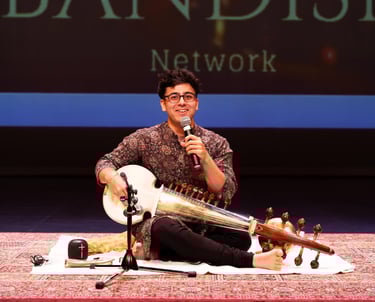
Rāga Sound Healing forms the central pillar of The Healing Arts Initiative. Drawn from Indian classical music traditions, rāgas are precise melodic frameworks refined over millennia, each aligned with specific emotional, psychological, and energetic states.
Unlike generalised sound baths, rāga sound healing is offered in its pure and unembellished form, without rhythmic layering, lyrics, or decorative instrumentation. When received through deep listening, rāgas function as vibrational medicine, engaging the autonomic nervous system, supporting brainwave synchronisation, reducing stress markers such as cortisol, and activating the parasympathetic response.
Traditionally, rāgas are understood to meet the listener’s internal state through resonance rather than stimulation, allowing natural recalibration and restoration to unfold. L: Hriday Raag presenting the Sarod at Arts BC 2024 provincial conference.

Indian Classical Dance as Yogic Practice
Movement as Embodied Listening
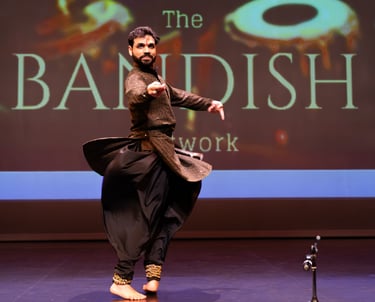
Indian classical dance is integrated within The Healing Arts Initiative as a yogic and somatic practice, not as performance. Rooted in Nāṭya Śāstra principles and classical movement lineages, this practice approaches dance as embodied meditation, breath-led gesture, and rhythmic alignment.
From both traditional and contemporary perspectives, rhythmic movement supports vestibular balance, emotional regulation, and nervous system resilience. Within this framework, movement becomes a method of internal listening, allowing sound to be absorbed, processed, and embodied through the intelligence of the body. Dance serves as a bridge between inner sensation and outer expression, restoring trust, rhythm, and coherence within the lived experience. R: Puneet Singh - Kathak Dancer and Movement healer presenting at Arts BC Provincial Conference 2024